Overview
Novale makes professional landscape design accessible to everyday homeowners. Hiring a landscape architect is expensive and out of reach for most people, so yards get designed by guesswork — or never get designed at all. Novale closes that gap: a homeowner enters their address, Novale reads the real property from satellite, soil, and site data, and they get a generated landscape design — with the reasoning behind every choice — that they can edit and make their own.
I took Novale from an idea to a working, AI-built prototype — design system, user flows, and a live demo — leading a small cross-functional team and using today's AI design and build tools end to end. It's the clearest proof of where my work is heading: product strategy and hands-on design, now amplified by the ability to build the thing myself.
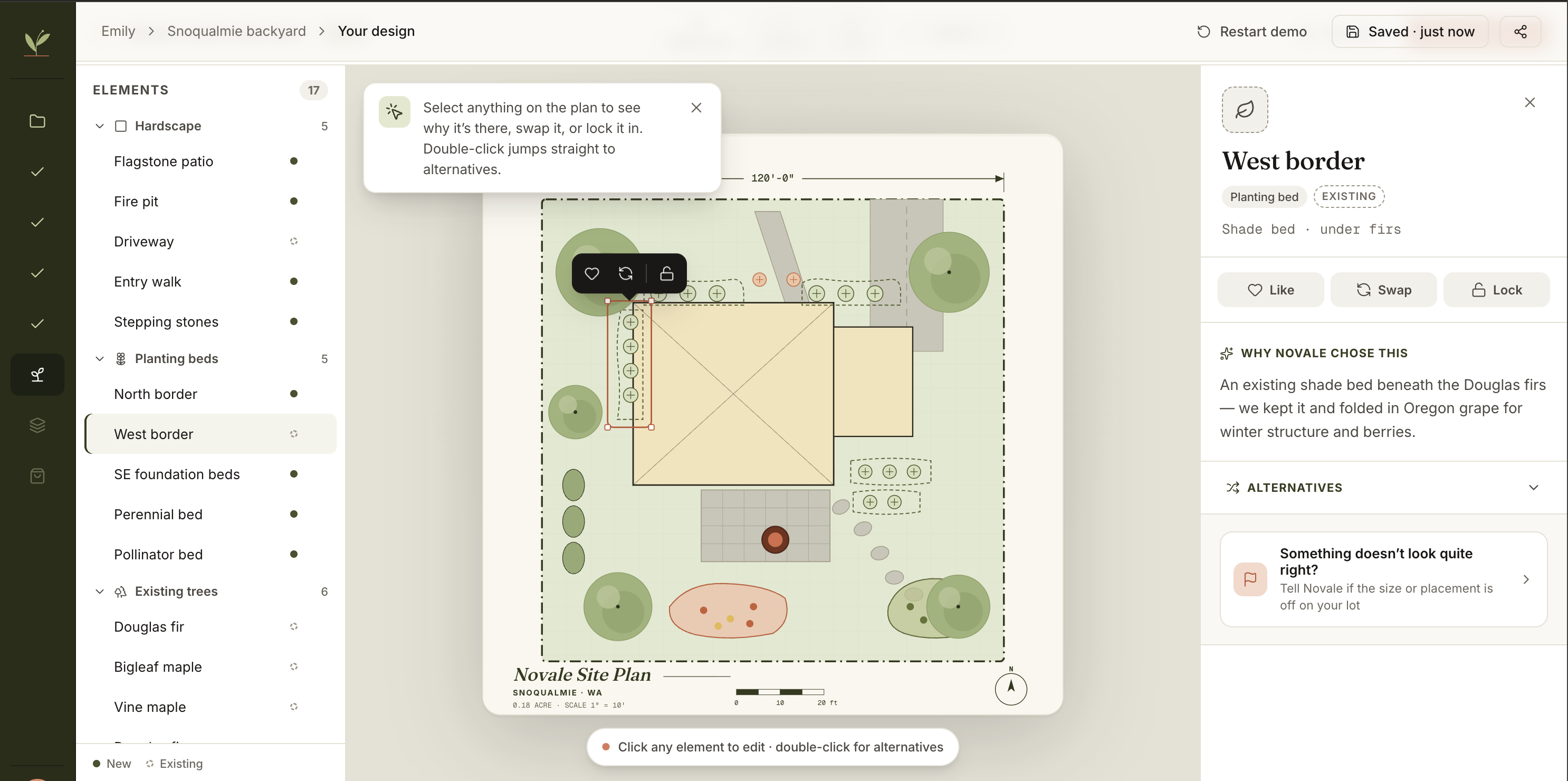
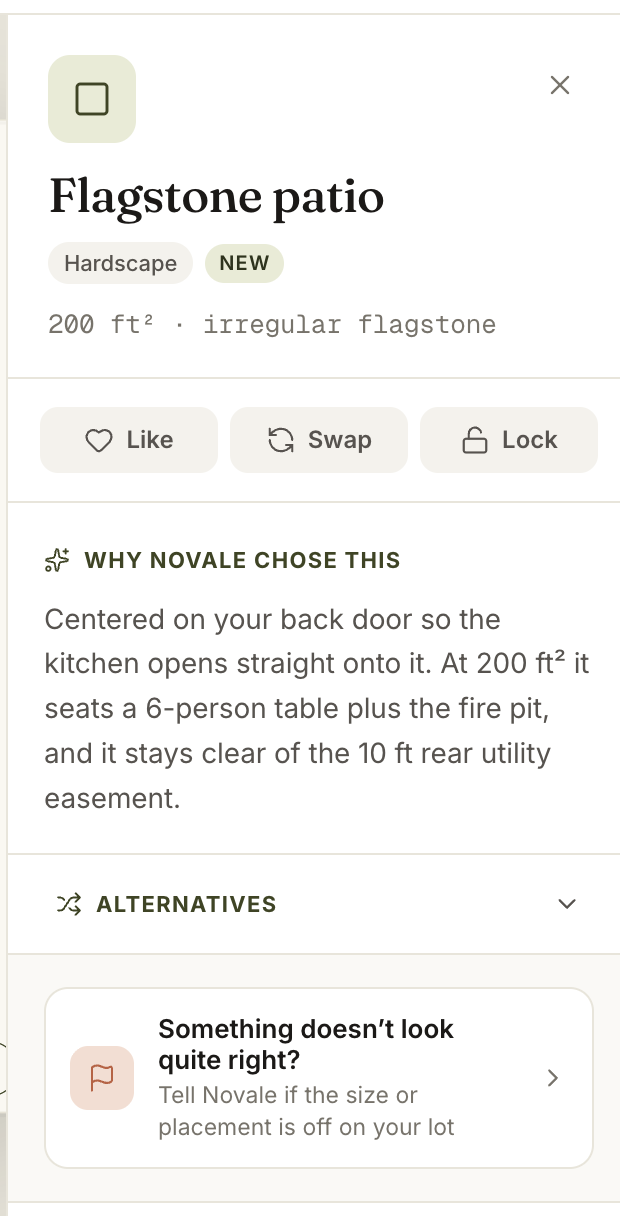
The Novale editor — every element on the plan is selectable, with the reasoning behind it and one-click swap, lock, or alternatives.
Novale is Latin for land newly cultivated — freshly broken ground, ready to plant. It captured exactly what the product gives a homeowner, so the name stuck. Before committing to it, I ran a preliminary trademark search to confirm the name was clear in the categories we'd be filing under.
My Role
I owned Novale end to end and built it myself: the product vision, the design system, the user flows, and the working prototype. What makes this project different from the rest of my work is that I didn't hand a design spec to an engineering team — using AI build tools, I designed, built, and deployed the entire prototype solo. An engineer advised from the start, and a landscape architect advised on the domain, but the build was mine. Now, with a working product in hand, that engineer is helping me scale it — making it work with real customer data and production AI workflows.
The Problem
Professional landscape design is expensive, slow, and intimidating. Most homeowners never hire an architect — they default to a few box-store plants and hope for the best, or they freeze, unsure where to even start. The expertise that would make the difference (what grows in their climate, what suits their site, how a yard comes together as a whole) stays out of reach.
The opportunity: put a landscape architect's way of thinking into a tool a homeowner can use in an afternoon — grounded in their real address and site, shaped by their taste, and editable so the design stays theirs.
Discovery
Before designing anything, I talked to homeowners. Across 15 in-depth interviews, the same need surfaced again and again: people have a vision for their yard but don't know which plants will work or how to bring it to life — and they want it made easy, end to end.
"I really struggle with what plants will work in my yard and how to plant them to get the look I want. I want a one-stop-shop that can get me to my vision with plants at my door ready to go in the ground."
— Fay, Des Moines, IA
"I would love to use this to redesign my yard. We have had our house for 8 years but I am not happy with the design we have now and want to ensure what we plant makes sense in place."
— Shirley, Carbondale, CO
Process
I used today's AI design and build tools across the whole arc of the work — from brand to a clickable prototype:
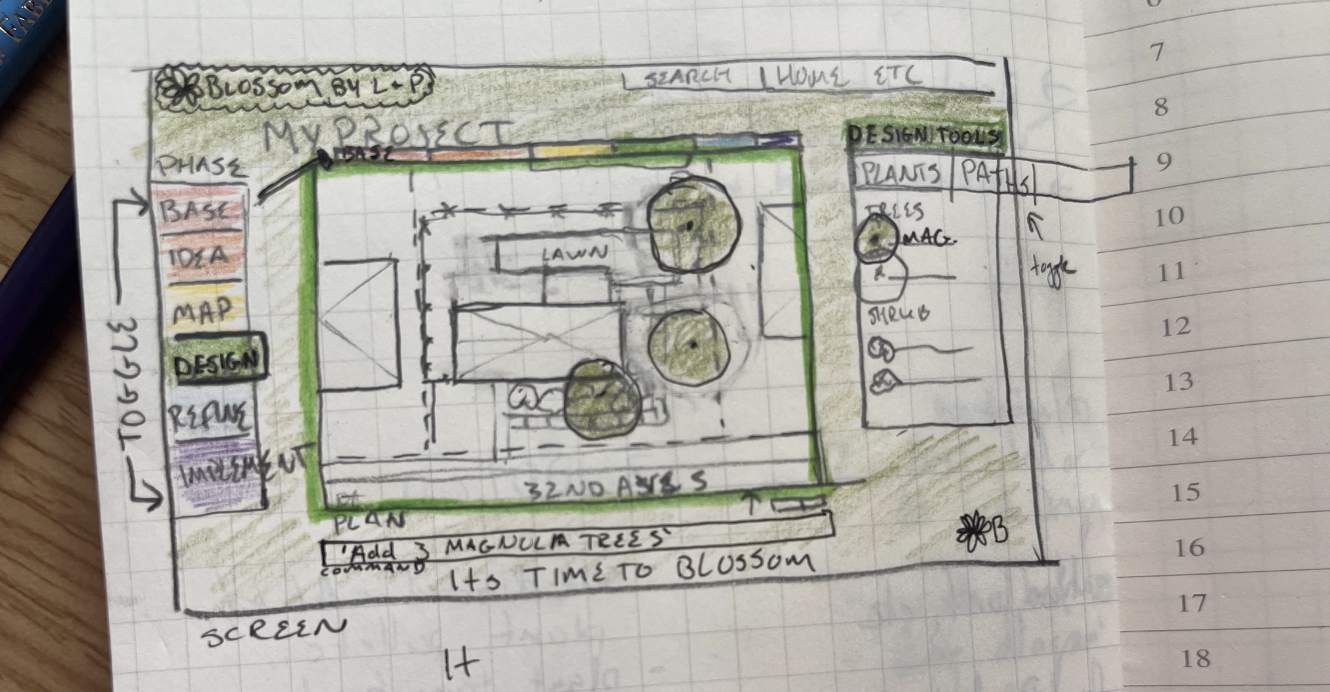
Where it started — an early sketch of the Novale experience, drawn by my partner Lauren, a landscape architect.
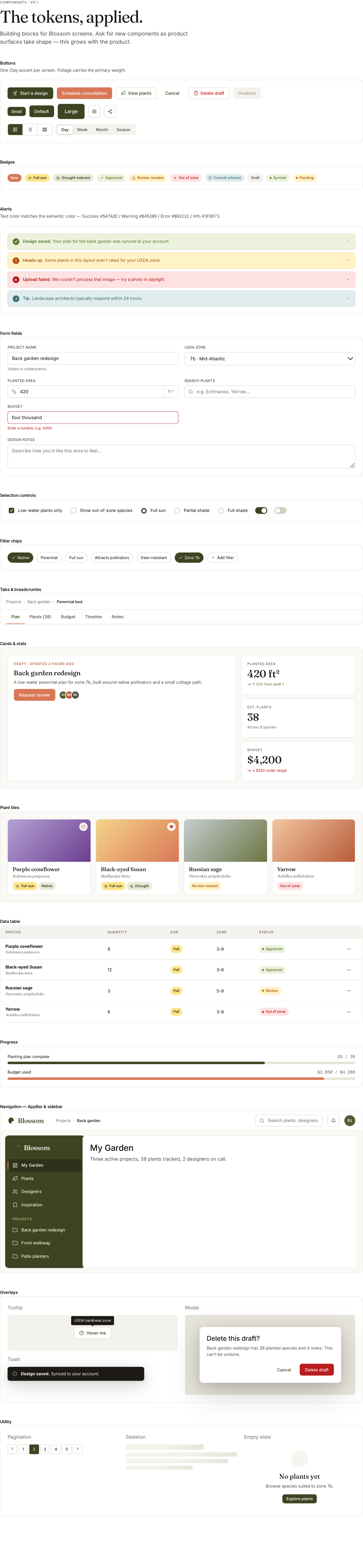
I started in Figma, selecting the fonts and core colors by hand to set the direction — then used Claude Design to generate and scale that into a full system: a five-color palette (Paper, Ink, Foliage, Clay, Sun) with tonal ramps and semantic tokens, a serif-and-sans type system, and the component library below.
The component library — the buttons, cards, inputs, and patterns that make up the Novale interface.
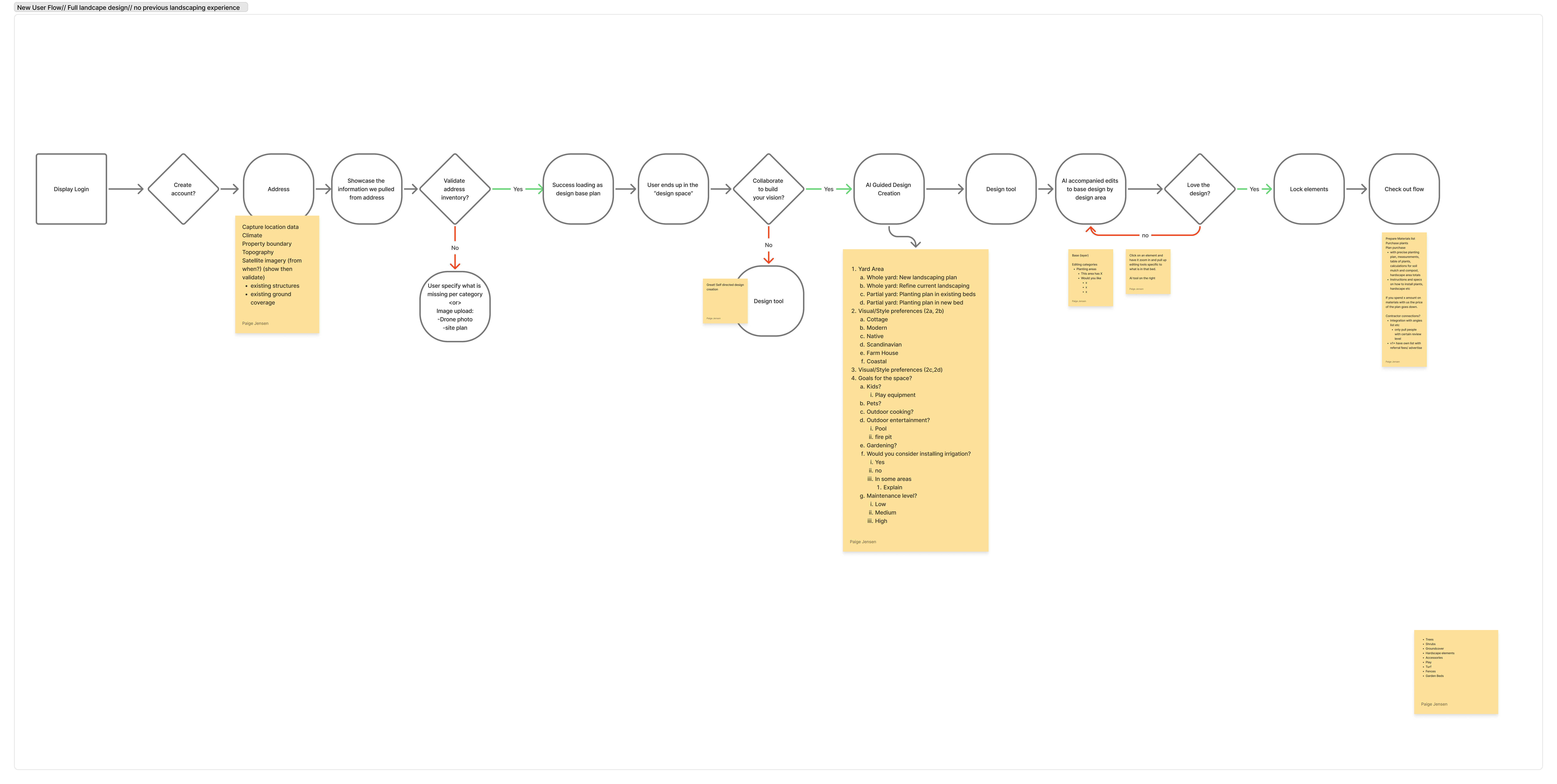
I mapped the end-to-end homeowner journey — the happy path from first visit to a finished, editable design — with the necessary inputs and sources tagged at each step.
The core user flow — the happy path, mapped end to end.
The Prototype
The prototype is a guided, multi-step flow that takes a homeowner from their address to an editable design — without ever asking them to think like a landscape architect. Two moments do the heavy lifting: reading the real property, and handing back a design the homeowner can actually steer.
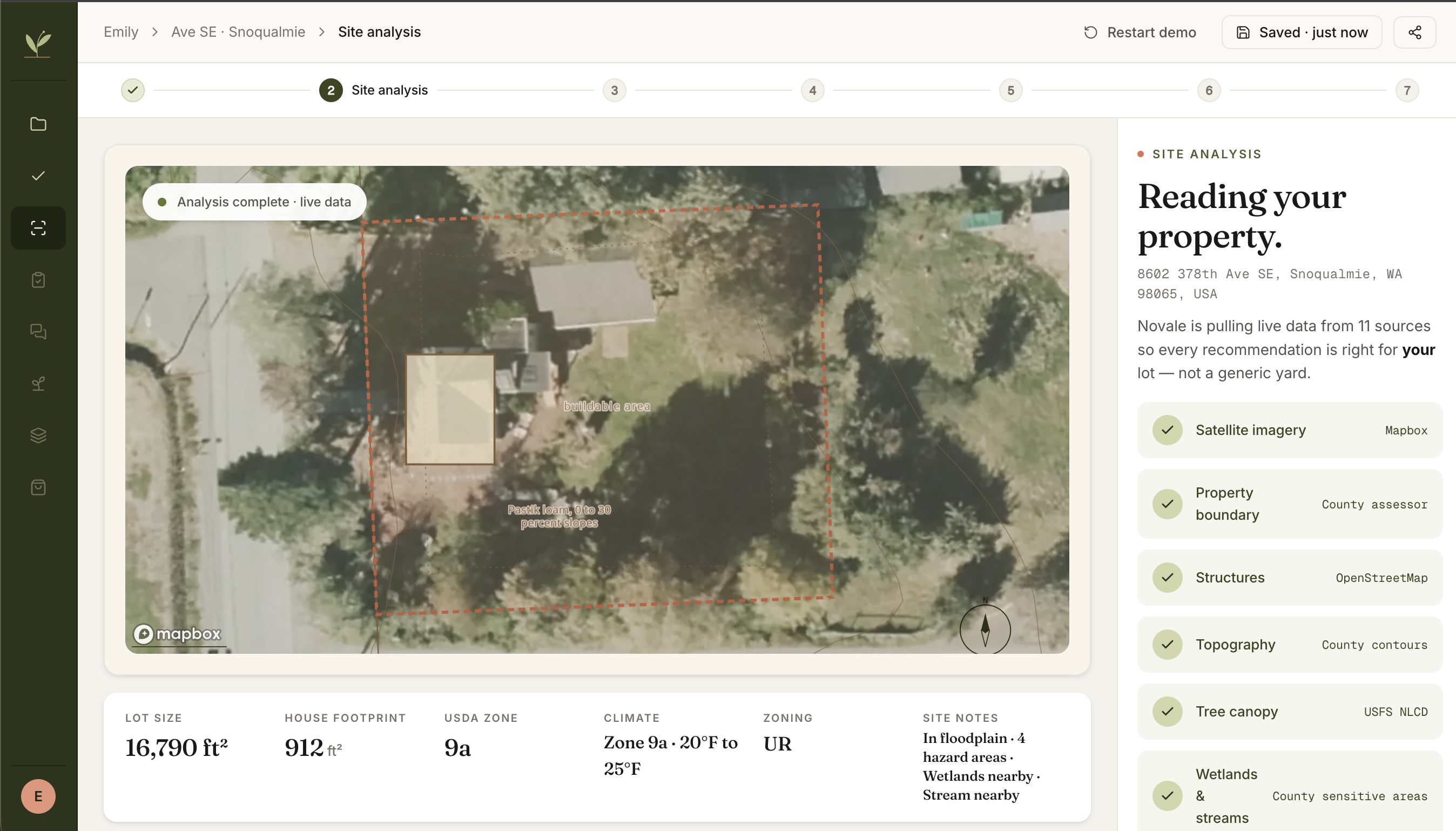
Before recommending anything, Novale analyzes the actual lot. It pulls from 11 live data sources — satellite imagery, county property boundaries, building structures, topography and contours, tree canopy, and wetlands, streams, and floodplain data among them — to map the property in real detail. The result is a site read with real specifics: lot size, house footprint, USDA zone, climate, zoning, and on-site hazards, so every recommendation fits this yard.
Site analysis — Novale reads the property from 11 live data sources, surfacing lot size, topography, tree canopy, wetlands, floodplain, and zoning before a single plant is placed.
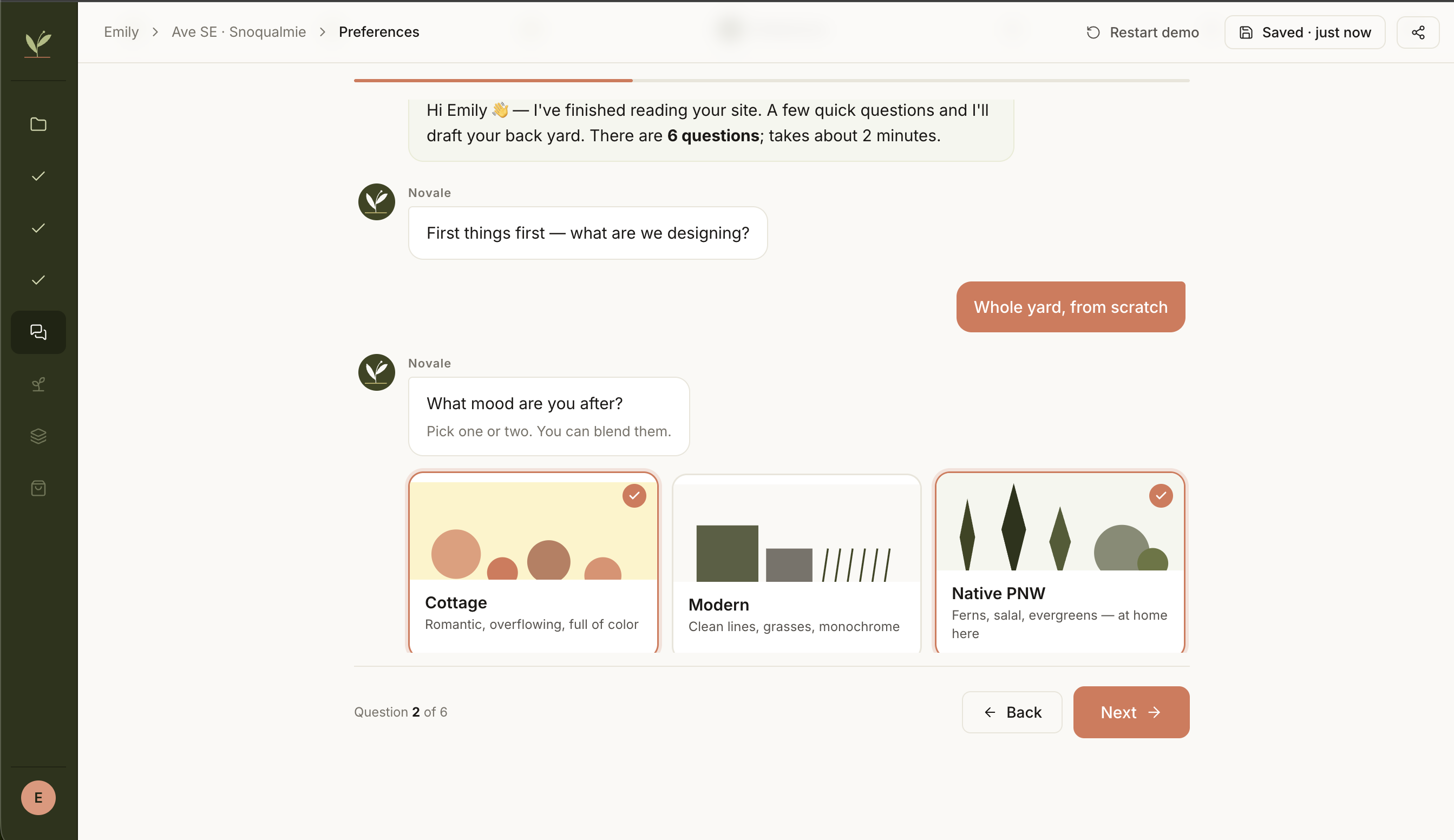
With the site read, Novale asks a short set of questions — six, in about two minutes — in plain, conversational language: what are we designing, and what mood are you after? Style is chosen by feel, with simple cards like Cottage, Modern, and Native PNW that people can blend. No jargon, no plant lists to wade through — just intent.
A short, conversational brief — Novale captures intent and style (Cottage, Modern, Native PNW) in about two minutes, before generating anything.
Novale generates a full site plan — hardscape, planting beds, and existing trees, organized into a clear elements list — then hands the homeowner real control. Select any element and Novale explains why it chose this, and offers one-click Like, Swap, or Lock, plus alternatives. A standing "Something doesn't look quite right?" prompt lets people correct size or placement on their own lot. The design is a starting point they own — explainable and editable — not a take-it-or-leave-it render.
Explainability & control
The detail panel turns a black-box generation into a conversation: each element carries its rationale, and swap, lock, and alternatives keep the homeowner in charge. That transparency is what makes a generated design feel trustworthy.
Validation
A working prototype is only half the story — the other half is whether people will pay for it. To pressure-test pricing, I surveyed 30 homeowners actively looking to improve their yards and gardens.
The headline result: target customers are willing to spend $100–$300 for an AI-generated landscape design package, with $500 as a soft ceiling and $1,000 as the walk-away. That validates my pre-survey estimate of a $75–$490 sliding scale — a tiered package priced to the size of the project.
The context made the demand credible. In the last year, the majority surveyed spent $1,000–$5,000 on products and materials for their yard. Half had paid for professional design services; the other half hadn't — and the non-payers overwhelmingly cited cost as the reason. That's precisely the gap Novale closes.
Sentiment toward AI-powered design was curious and excited. Many followed up personally with anecdotes about how Novale would have helped them arrive at a plan, or get on the same page with a contractor.
When asked what would further incentivize purchase, two features scored highest:
That feature interest points to an add-on subscription tied to the user's design — year-round yard and plant management at $5–$15/month with annual discounts, in line with plant-care apps like Planta. The one-time design draws people in; the management subscription keeps the relationship going.
Delivery
On most of my projects, delivery means handing a design spec to an engineering team. On Novale there was no team: I did all of the design and all of the build myself — vibe-coding the prototype in Claude Code and deploying it live through Vercel. The thing you can click is something I designed, built, and shipped end to end.
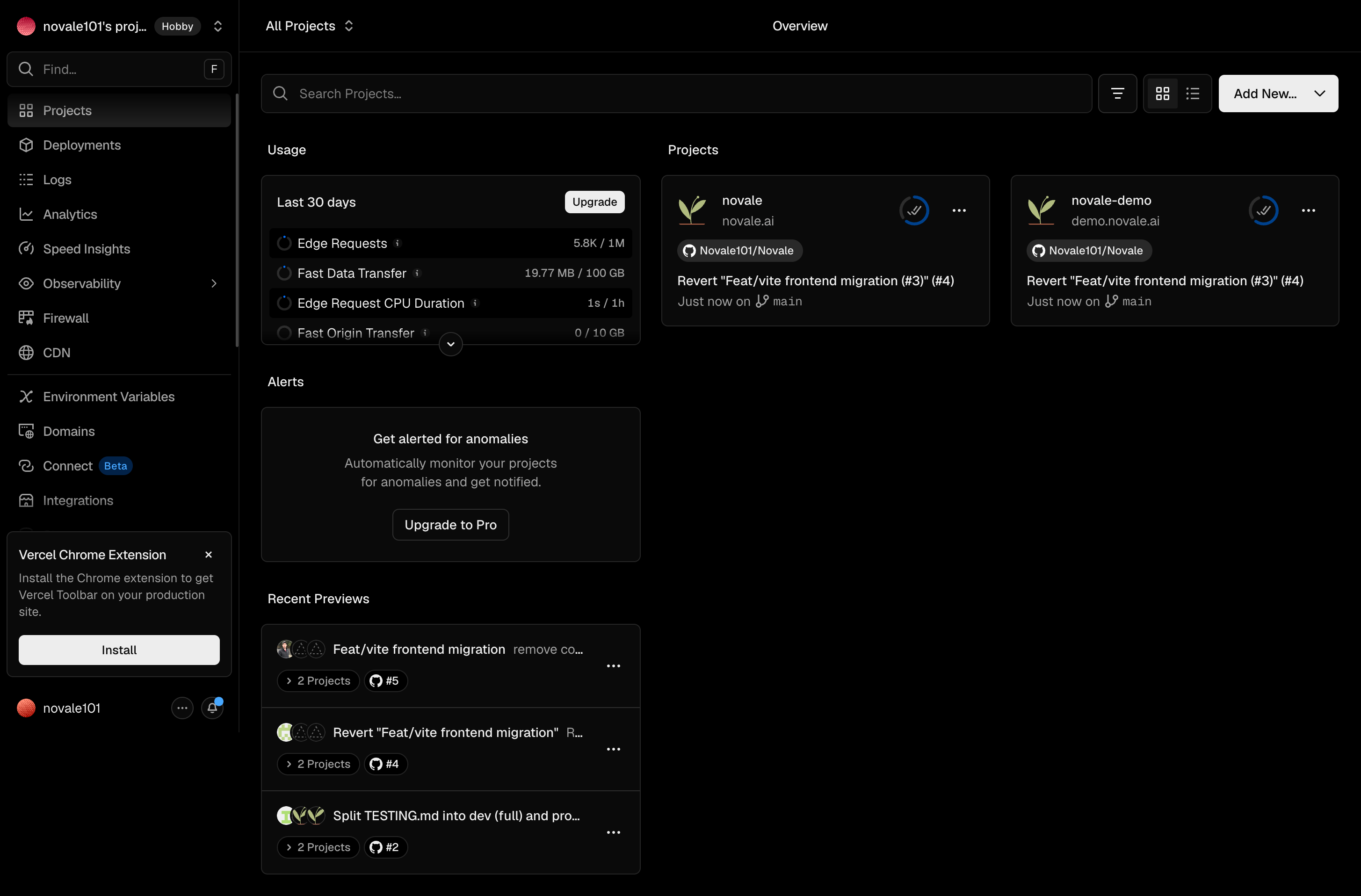
My Vercel workspace — both novale.ai and demo.novale.ai deployed and live, with real usage and preview builds, all shipped by me.
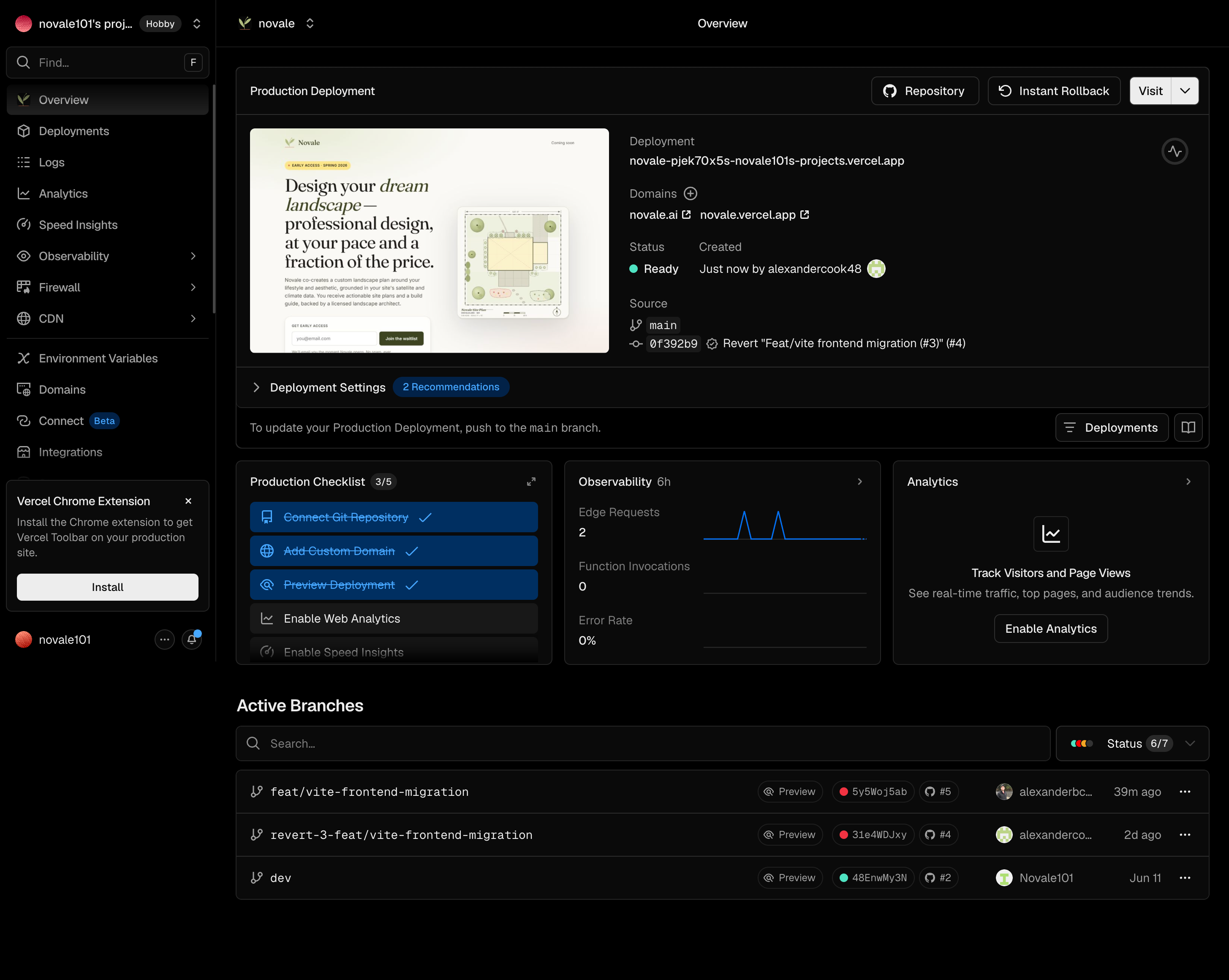
novale.ai — the production deployment I shipped: custom domain connected, status ready, serving the live site.
The takeaway I'm carrying into my next role: a product-and-design leader who can design and ship the working prototype changes what handoff means. I don't hand engineers a wireframe and a doc — I hand them a running, deployed product and a proven direction, then partner on making it production-real.
What's Next
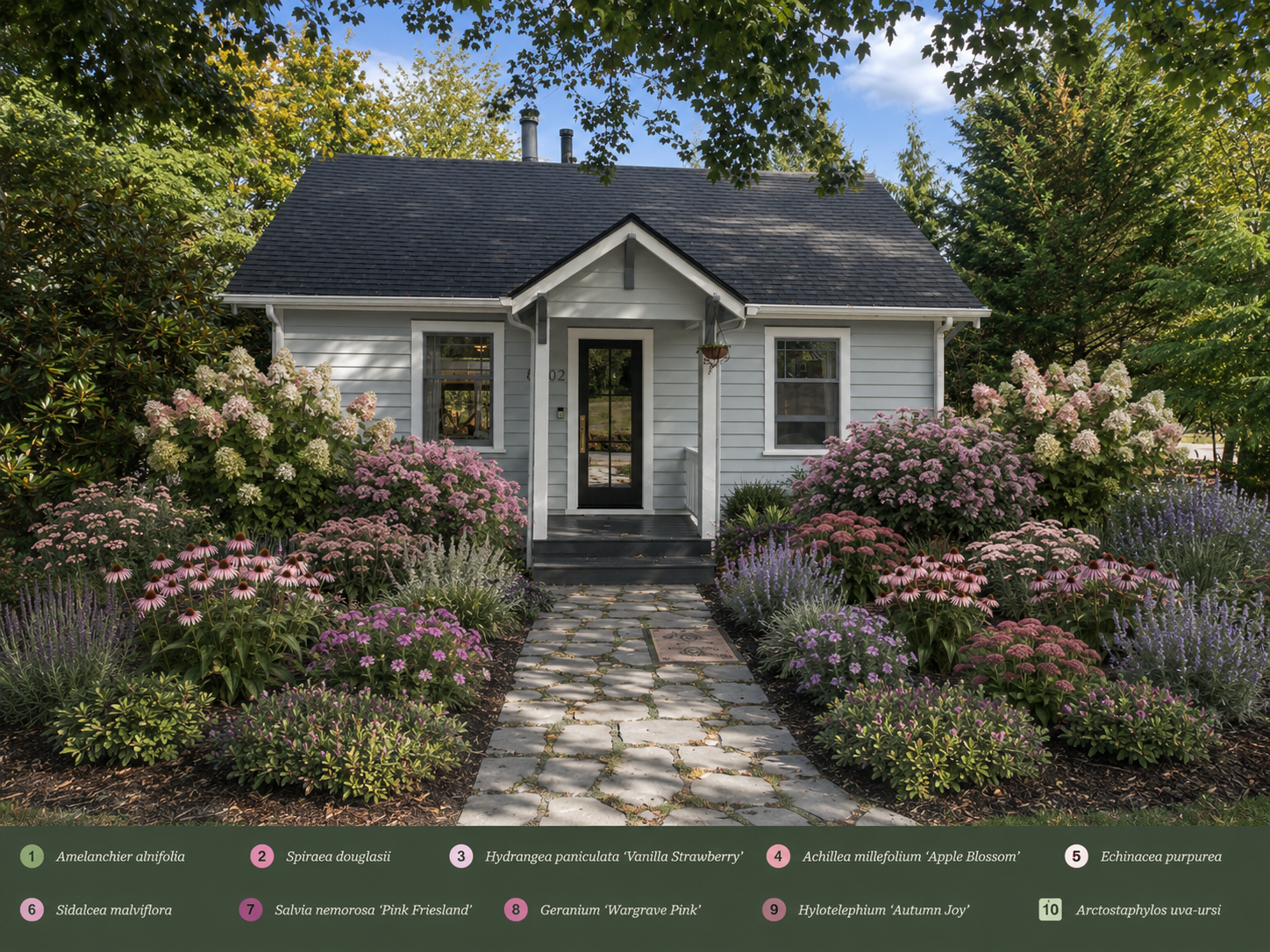
A site plan tells you what goes where. Most homeowners need to see it. The next leap for Novale is turning a design into a photorealistic, plant-accurate render of the actual home — so people can stand at their own front door and picture the result before they plant a thing.
The image below is an early proof of that capability: an AI-generated render produced from a detailed plan, showing the home as it could look once the design is in the ground. It isn't a Novale feature yet — it's the target that's shaping how we implement the AI from here, and exactly the kind of problem the engineer and I are now tackling together as we scale.
An example AI render generated from a detailed plan — photorealistic and true to the home. This is the capability Novale is building toward.
The Team & The Reflection
I carried Novale from idea to working prototype almost entirely on my own — with a landscape architect advising on the domain and an engineer advising from the start, who is now helping me scale it. Discovering how to best leverage today's tools, shipping code myself, and getting to be highly strategic and execute at the same time was genuinely exciting — and proof I can hold vision and hands-on building at once.
After some reflection and three months of focused work on Novale, I remembered my favorite part of any work is the team. So my next chapter will be integrating what I learned here, at scale, with people I can build alongside, mentor, and learn from.