Overview
Loresse is a workflow-optimization operating system that captures and recreates the tasks an organization's top performers do best. Built on transparency by design, every step it takes is tracked and user-validated — nothing happens in a black box — and the platform learns by watching its digital twin do the work, getting smarter while keeping the human in control.
I led experience design for Loresse at Persistent Systems, taking it from concept to its first working prototype — the version that, when it walked into the room, landed the company's first client and helped raise $4M.
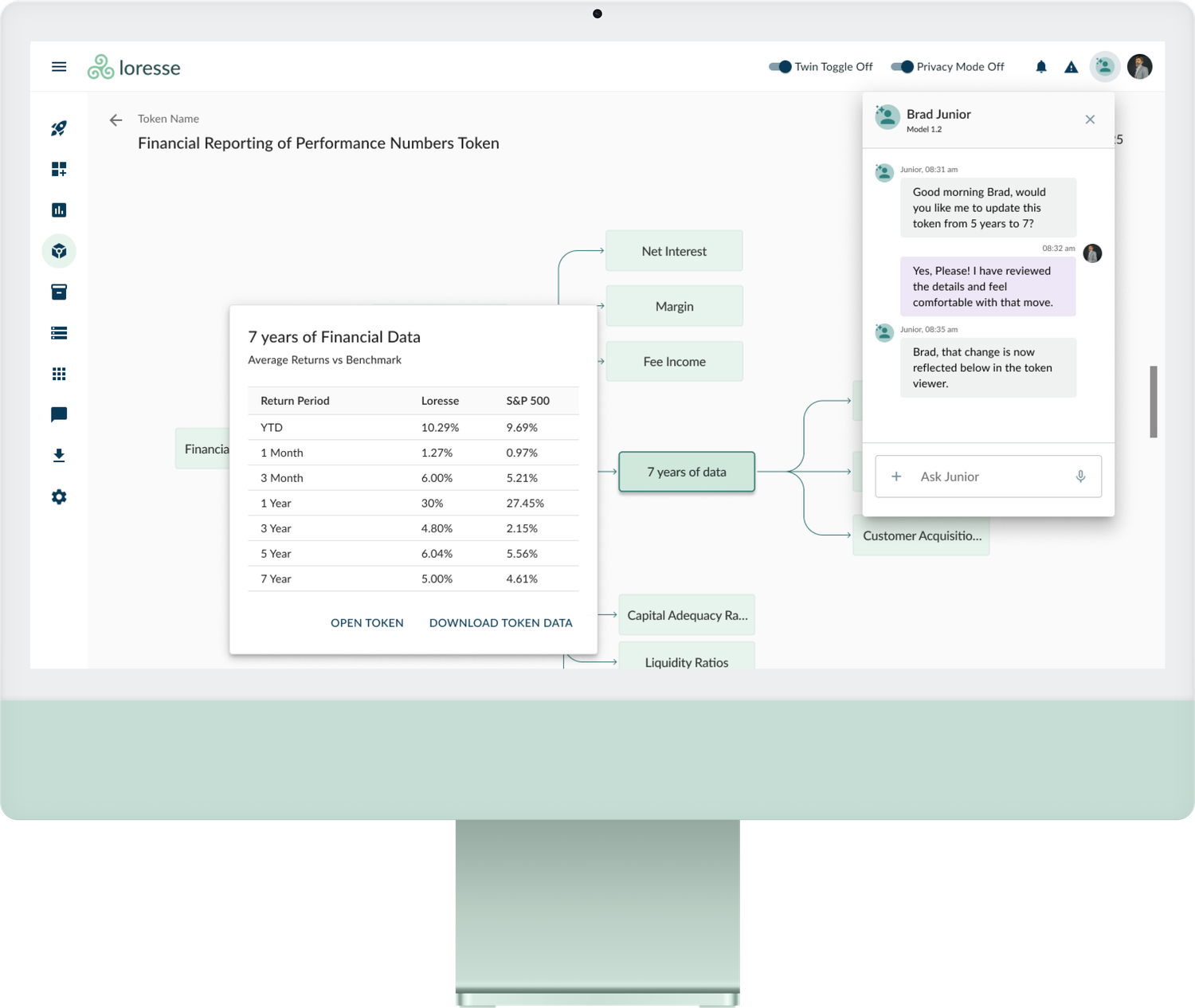
A work Token, opened up — and Junior, the digital twin, asking permission before it changes anything.
The Challenge
In any organization, a handful of people simply do the work best — they know which numbers matter, which steps to trust, and when something looks off. That expertise is the business's real engine, and it's almost entirely undocumented. When those people are busy, out, or gone, the quality goes with them.
AI promises to close that gap, but in a regulated, high-stakes domain like financial markets, a black box is a non-starter. Teams won't — and can't — hand critical work to a system they can't inspect. The design challenge was to make an AI that earns trust by being legible: powerful enough to do the work, transparent enough that a person stays accountable for every step.
The Idea
The core move was to make the AI's work visible and reversible at every step, rather than asking people to trust an answer. Work is captured as Tokens — the discrete tasks an expert performs, broken down into their underlying data elements. A digital twin runs those Tokens, and it learns by watching the real expert do the job.
Crucially, the twin never acts alone. It proposes, and a person disposes: it asks before it changes a Token, routes anything that drifts from the norm up an approval chain — first line, second line, C-suite — and surfaces a Twin Toggle and Privacy Mode so the human decides how much autonomy to grant and what stays private. The result is an AI that gets more capable over time without ever becoming a black box.
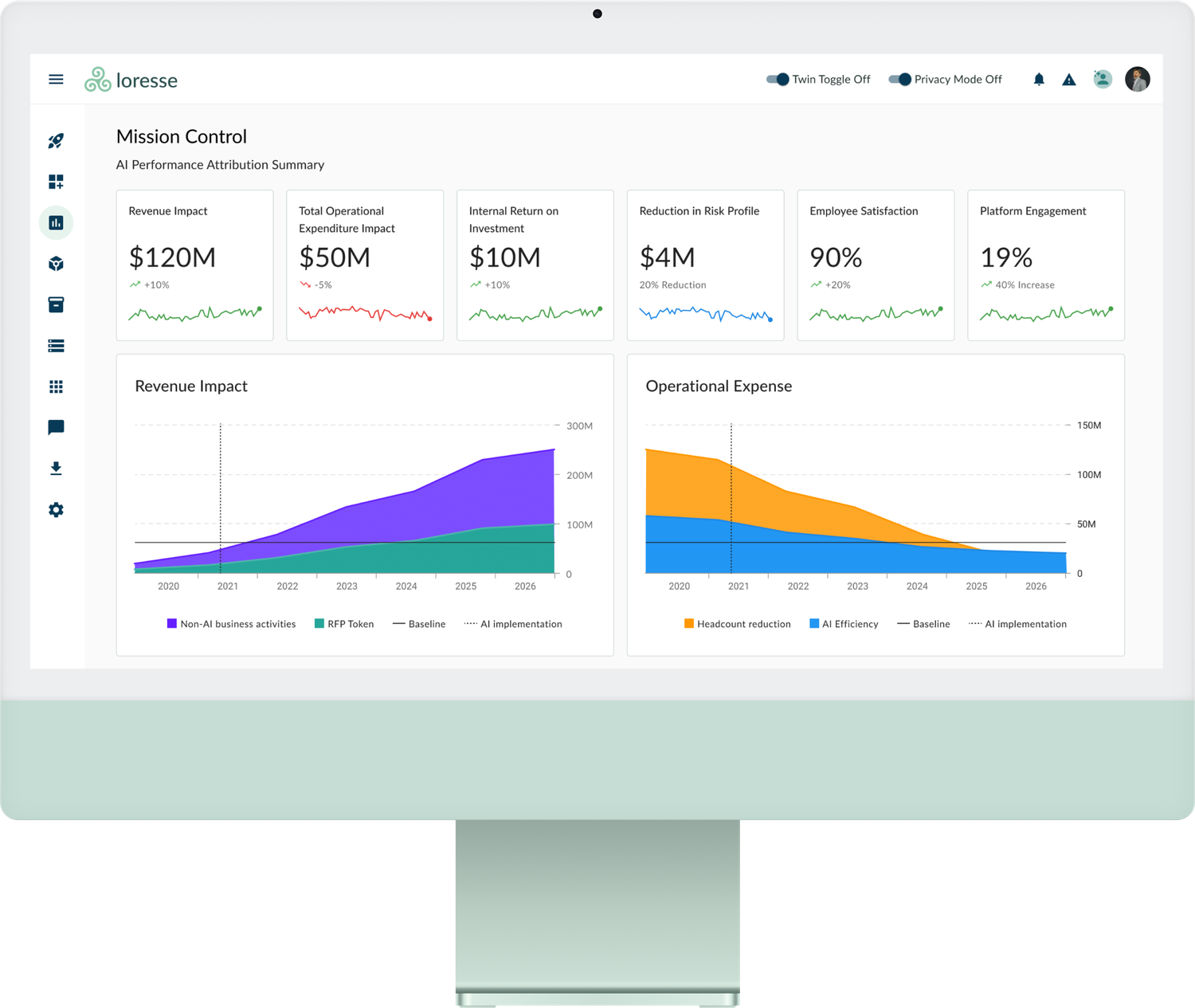
Mission Control — the enterprise view of what the twin is doing and the impact it's driving.
The Product in Motion
This is the demo we built to tell Loresse's story — the one that landed the first client. I creative-directed the video end to end, shaping the narrative, the pacing, and how the product reveals itself.
The Loresse demo — creative direction by Paige Jensen.
The System
Loresse is organized so a person can move from a single task all the way up to the health of the whole operation without losing the thread:
My Role
I led a three-person experience design team from concept through Loresse's first prototype and its launch marketing video. I drove discovery through delivery: founder working sessions and a competitive audit of the AI landscape to frame the product, rapid low-fidelity iteration to align stakeholders fast, and a scaled Material UI design system to keep the build consistent — all validated with stakeholders and pilot customers.
As the work moved toward engineering, I coached the designer on the team through a clean handoff, so the quality we designed survived into the build. And I creative-directed the launch video that carried the story out into the market.
Outcomes & Impact
Loresse is early, but the prototype already earned its keep: presented to the market, it landed the company's first client — a financial-markets pilot — and helped the company raise $4M to build it for real.