Design System at Scale — Director of Product Design
Role
Director of Product Design
Company
Concentrix
Dates
Jun 2024 – Dec 2024
Team
Led a cross-functional team of 5+ — design, research & engineering
Workstreams
Design System · PDLC · GILEs
80%
Design-system adoption across a new 500-person, 20-team AI org
Overview
One design system for a new 500-person AI organization
Concentrix spun up a new technology organization — roughly 500 people — with a mandate to build AI-enabled tooling, but no design function, no shared system, and no common process to build on. As Director of Product Design, I made the foundational bet — a single design system the whole org could build on — then used the org's flagship AI tools as the place to prove it.
The system came first: I directed a team to build a Material UI–based design system and drove its adoption across the new org, so 20 product teams shared one language for design and engineering. Then came the proving ground — PDLC, an AI-enabled tool that streamlines the entire product-development lifecycle, and GILEs, a developer co-pilot — both built on the system, and both where I shaped how AI showed up for the people doing the work.
Because PDLC and GILEs were generative-AI products, the design work wasn't only screens and flows — it was defining where AI added value and making that legible to the people who would rely on it. Rather than bolting AI on at the end, I wove it into the process itself: specifying, step by step, how AI would show up for the people doing the work.
My Role
Director-level scope: vision, teams, and a foundation for the org
As Director of Product Design, I owned design across all three workstreams and led a cross-functional team of 5+ spanning design, research, and engineering. This wasn't a single-product brief — it was building the design function for a brand-new organization while shipping AI tools at the same time.
The work was as much leadership and strategy as it was design. I managed executive stakeholders directly — facilitating workshops to extract and map their vision for an AI-enabled product process in its entirety — then translated that vision into research, a design system, and shipped tooling. I set the direction; I built and guided the teams; and I made the calls on where AI belonged and where it didn't.
The Challenge
A brand-new org with no design function — and a mandate to build AI fast
A ~500-person organization had been stood up with no standardized process, no shared design system, and no design function to anchor any of it. The executive team wanted to use AI to streamline the product-development lifecycle — but had no clear picture of what that lifecycle actually looked like across the org.
My mandate was to establish the design foundation and ship AI tooling in parallel: build a system the whole org could share, extract and map a process no one had documented, and turn it all into products people would actually use — starting from near-zero on every front.
The Foundation · Design System
One design language for 500 people
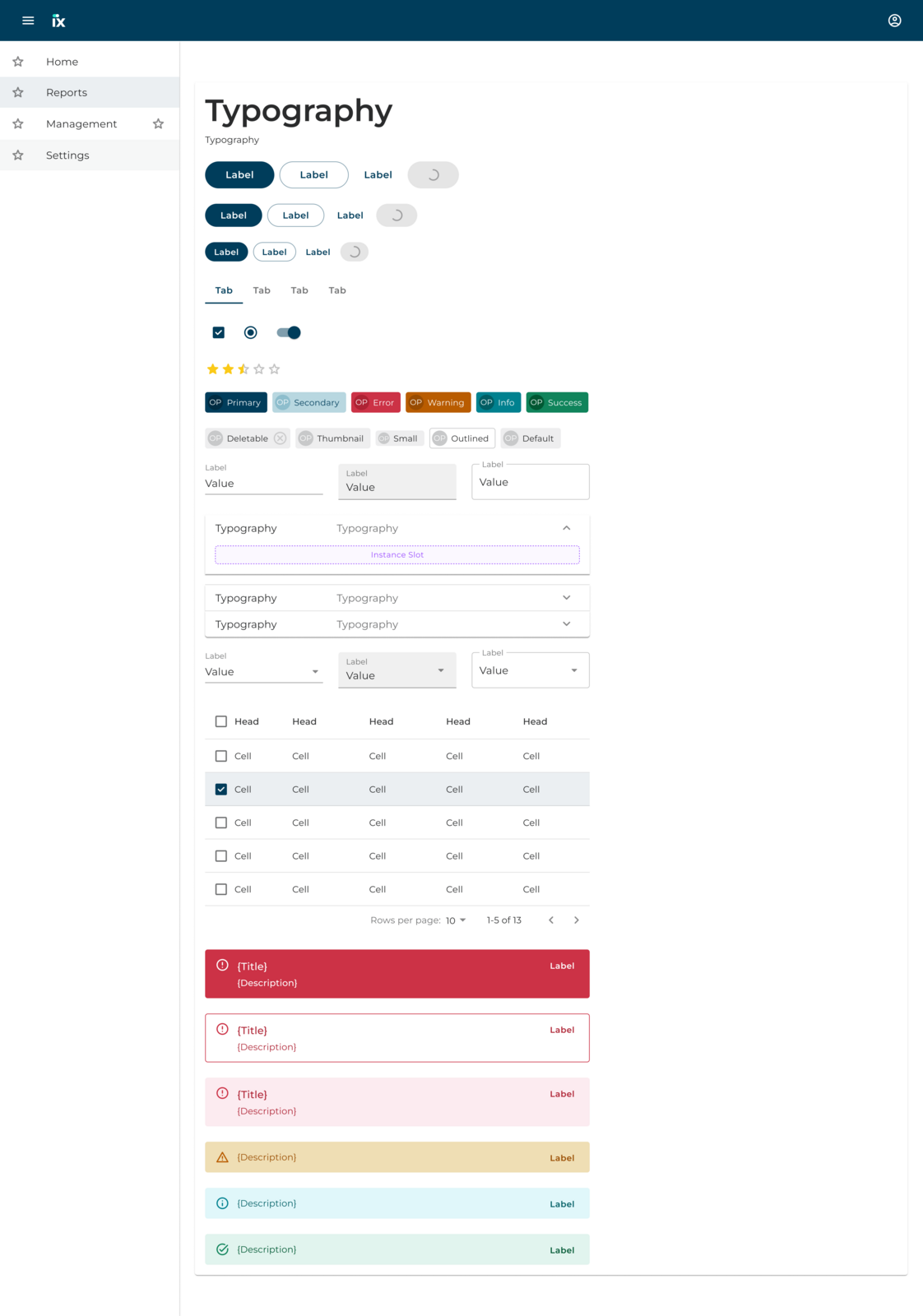
A new org of that size, building fast, was on track to produce a dozen inconsistent interpretations of the same product. Before any of that calcified, I directed a team to stand up a shared design system — we built on Material UI (MUI) for speed and engineering alignment, then extended it with the components and patterns our AI tools actually needed.
Building it was only half the job. I evangelized the system across the new organization — and it landed: all 20 product teams in the GPO, roughly 500 people in total, adopted it as the common language for design and engineering. One coherent foundation, used org-wide, that outlasted any single product.
The iX design system — a shared component library (built on Material UI) covering typography, controls, data tables, and status patterns.
The System, Applied · PDLC
PDLC — an AI tool to streamline the entire product lifecycle
With the design system in place, PDLC was the first large-scale test of it — an executive vision for an AI-enabled tool to streamline how the whole org takes a product from idea to launch. My job was to turn that ambition into something real — extracting the vision, understanding the actual process, and designing AI into every step.
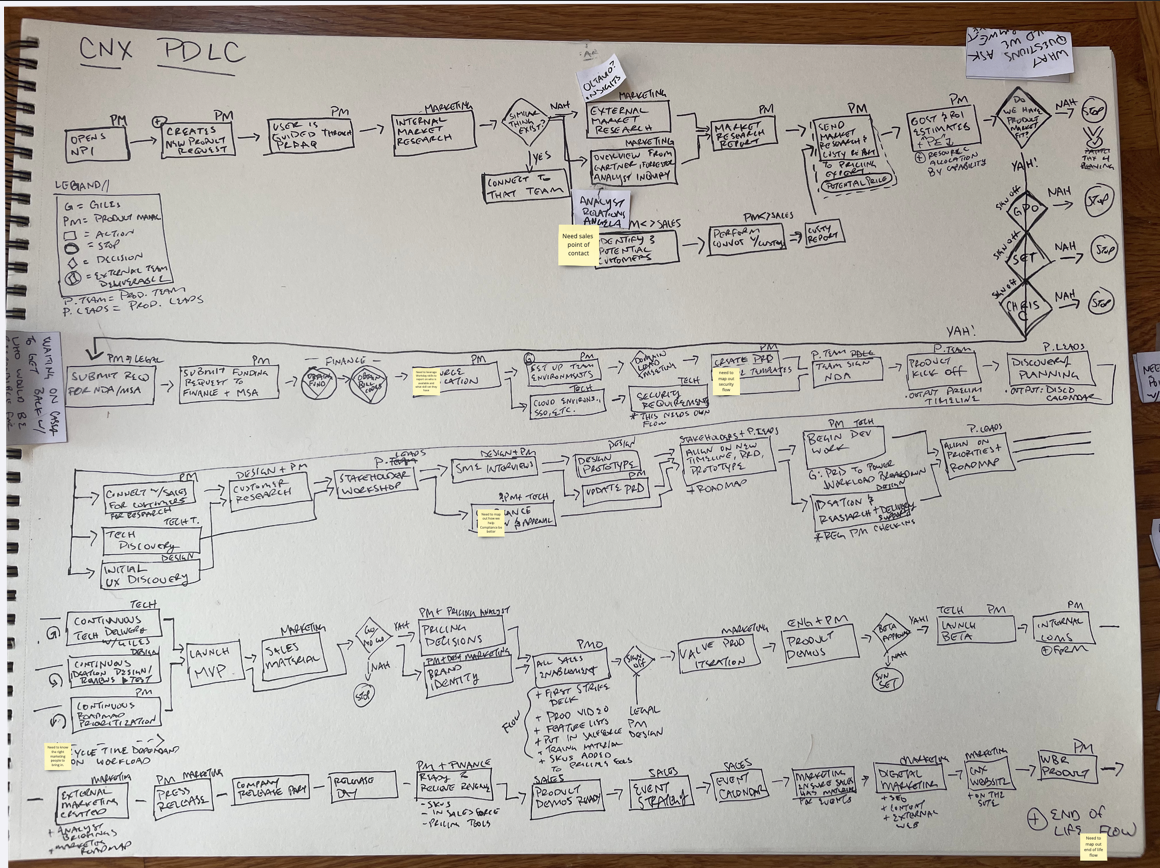
1 · Extract the vision — executive event mapping
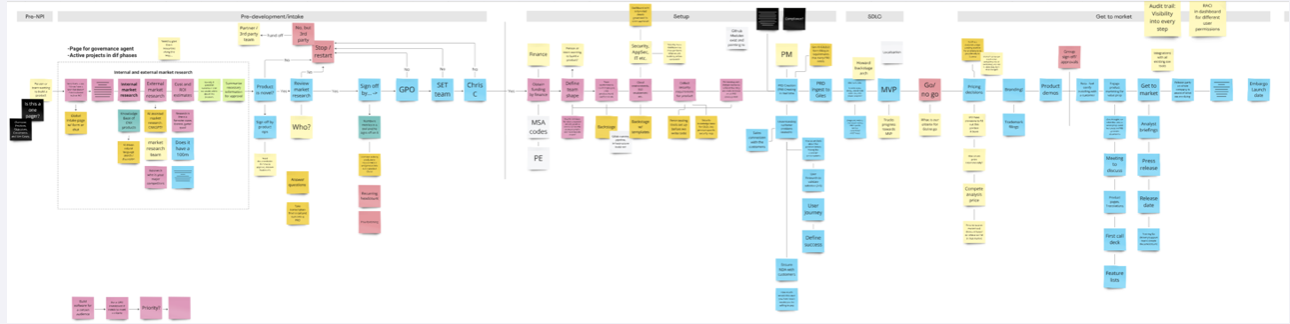
I facilitated event-mapping workshops with the executive team to pull their vision for the AI-enabled process out of their heads and onto the wall — mapping it in its entirety and establishing a shared language before any design began.
Event-mapping workshop — the executives' intended product process, mapped end to end.
2 · Understand reality — SME interviews
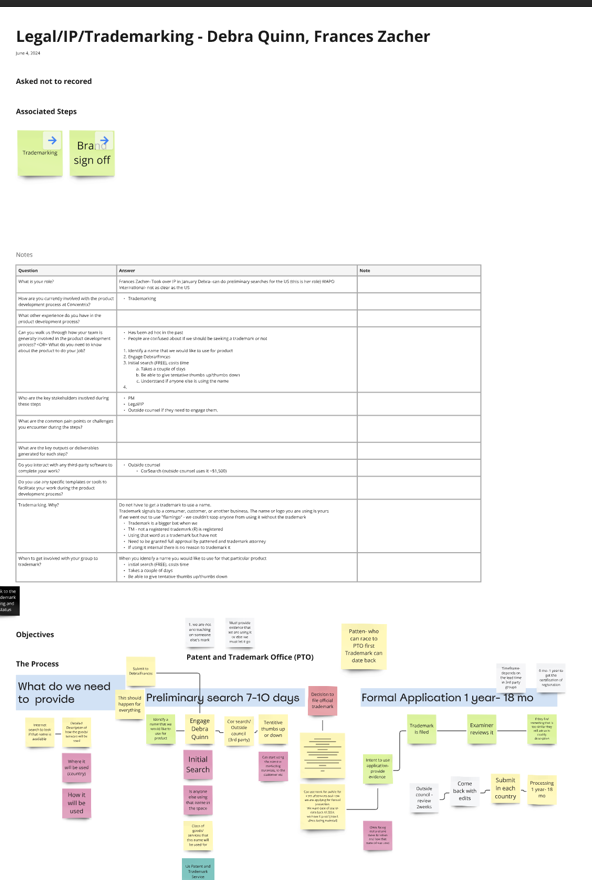
I interviewed subject-matter experts for every step of the lifecycle — 24 in all — to learn how the work actually happened, where it broke down, and where AI could meaningfully streamline each step. The gap between the intended process and the real one reshaped the product's scope.
One of 24 SME interviews — surfacing how each step really worked.
3 · Synthesize — process research
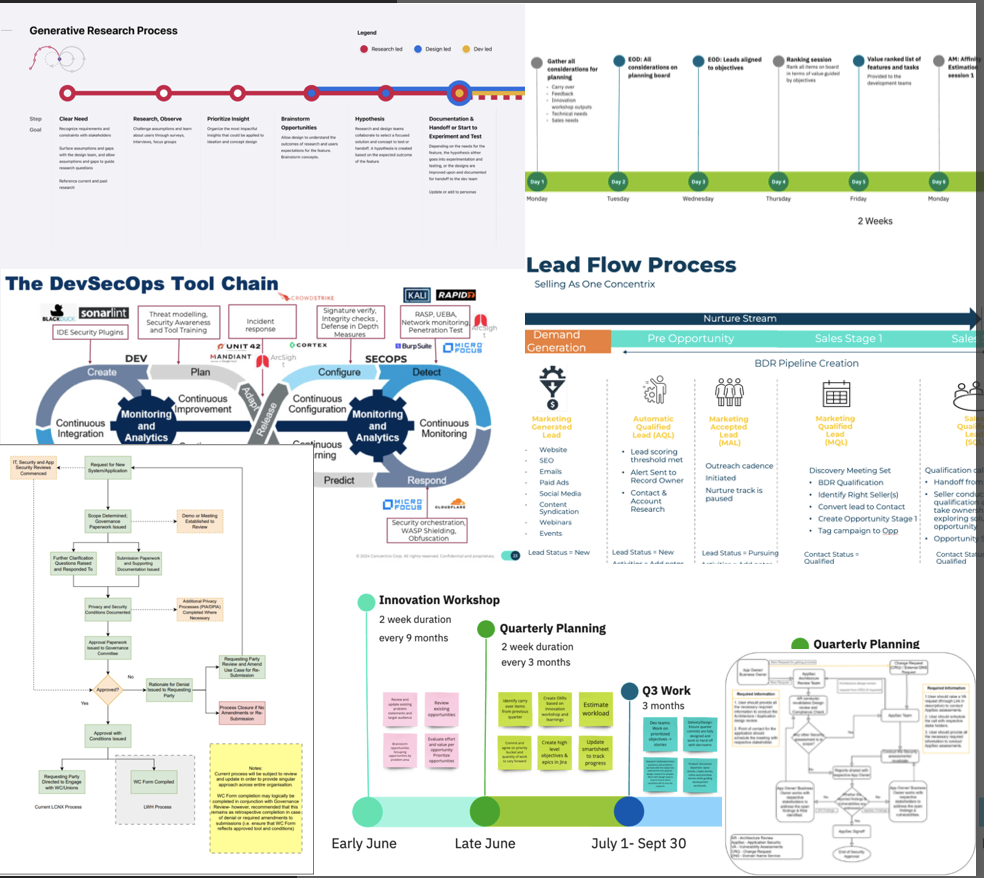
I gathered the process documentation scattered across the organization and synthesized it into one coherent picture of the product-development lifecycle — the source of truth the tool would be built around.
Process research — scattered documentation pulled into a single picture.
4 · Map it together — and design AI into every step
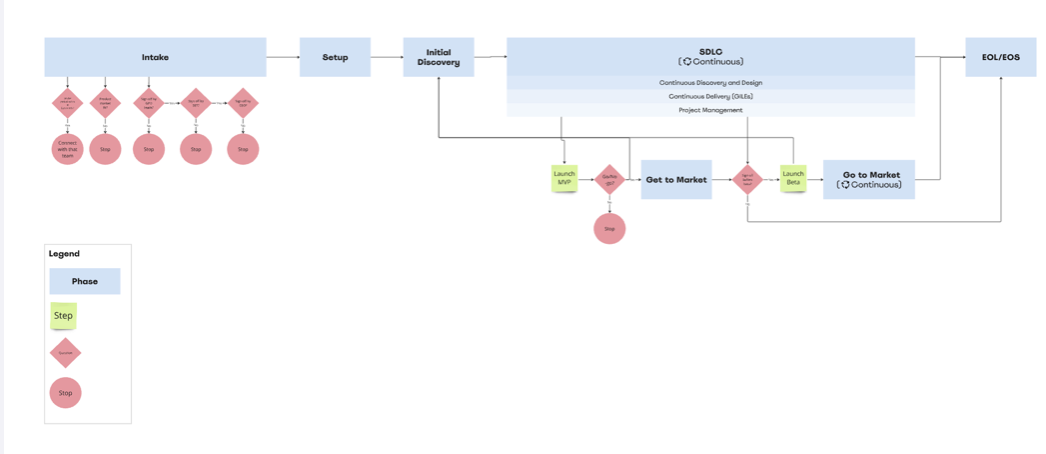
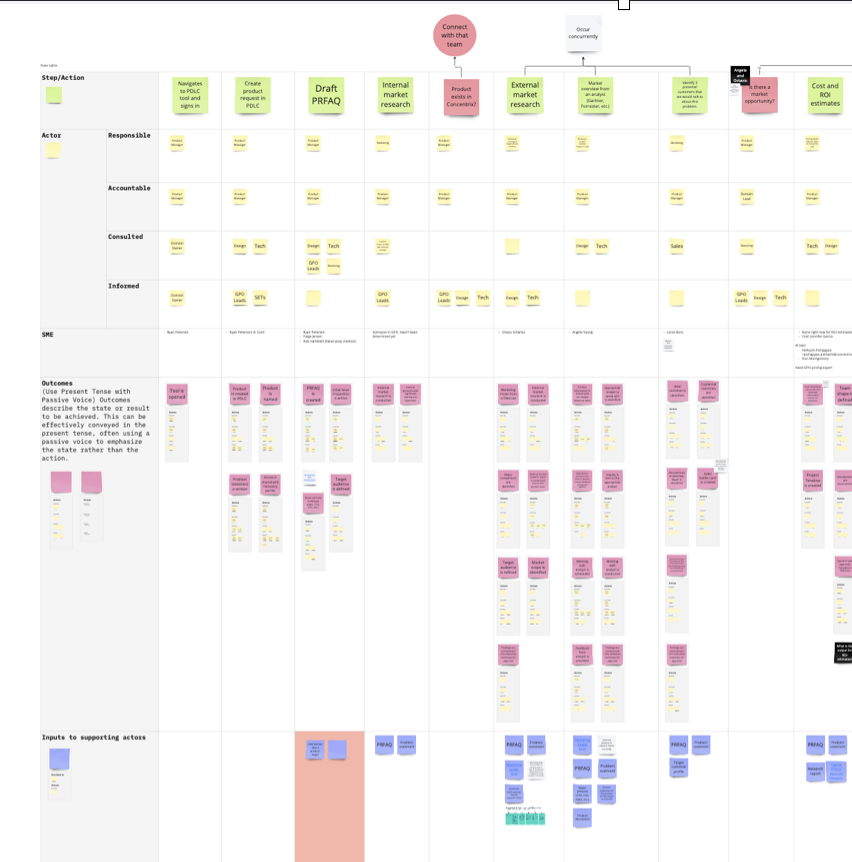
I mapped how all the steps connected into one end-to-end flow, capturing the outcomes, RACI (who's responsible, accountable, consulted, and informed), inputs, and — critically — how AI would show up at each stage. Rather than treating AI as a feature bolted on at the end, I wove it into every step of the process, so the team and leadership were aligned on exactly where and how it added value.
The full lifecycle, mapped as one connected flow.
High-level blueprint of the lifecycle stages.Deep-dive flow for a single phase, with AI opportunities called out.
5 · Design it — wireframes
I translated the research into wireframes — testable flows for how a user would move through each stage of the lifecycle inside the tool.
Wireframes — research turned into navigable, testable flows.
6 · Ship it — the live PDLC tool
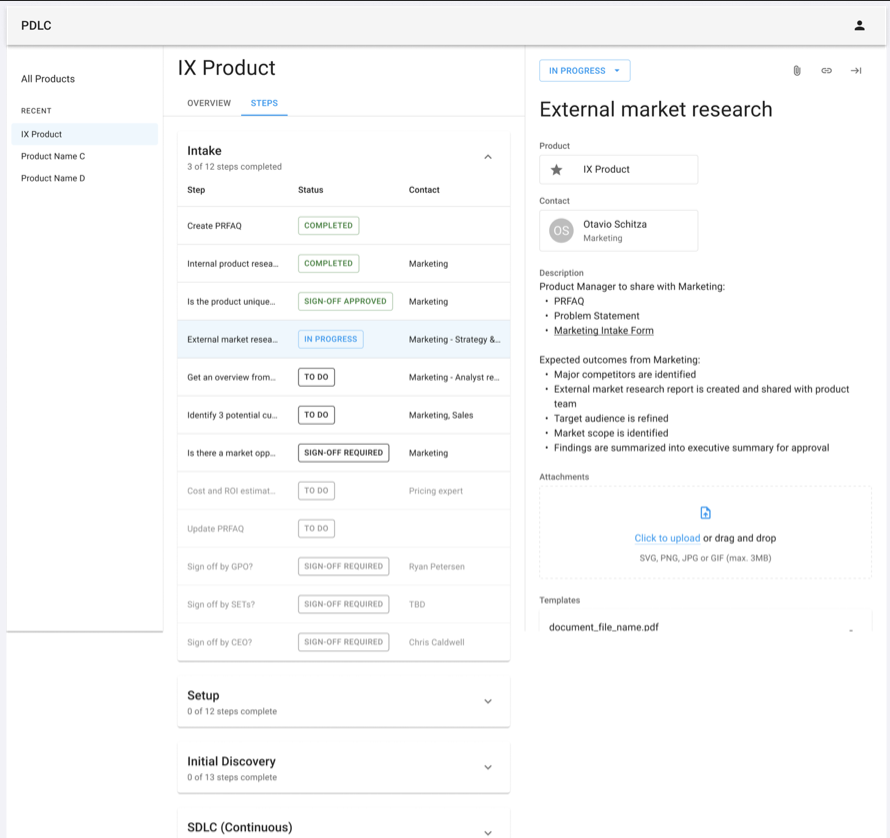
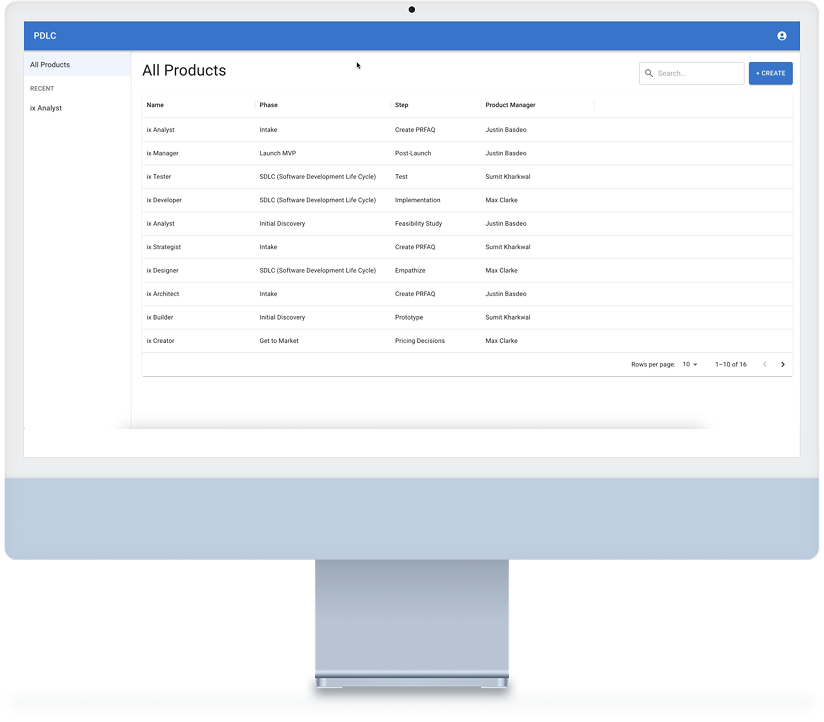
The essential steps launched as a live internal product. The PDLC tool tracks every product across its lifecycle stages — from intake and discovery through definition, build, and launch — with AI filling the gaps at each step.
The shipped PDLC tool — every product, tracked across its lifecycle stages.
The System, Applied · GILEs
GILEs — a developer co-pilot, made usable
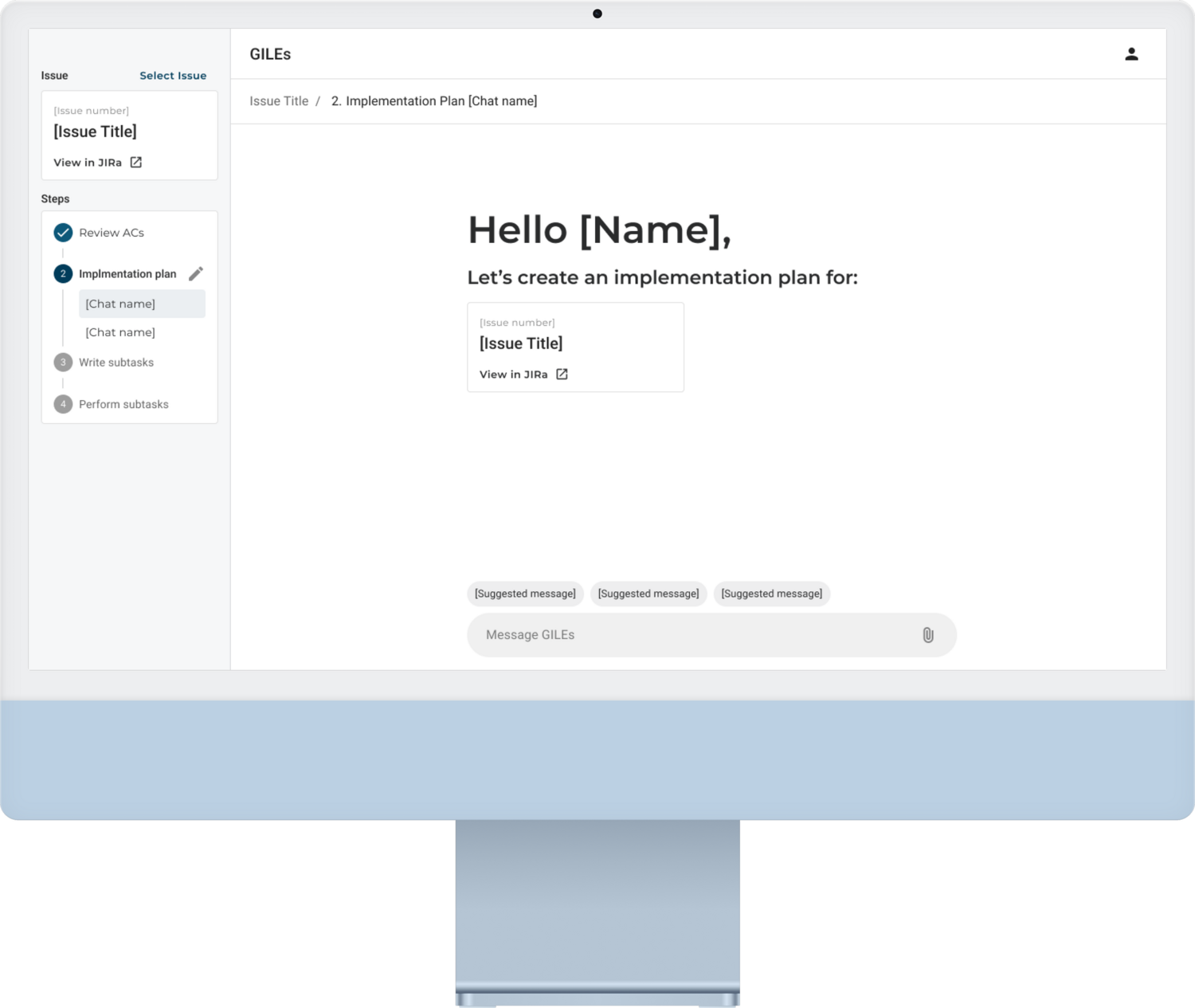
GILEs put the design system to work for a different audience — engineers. It was a developer co-pilot with a strong premise — reduce the time engineers spend on repetitive work around a ticket — but a UX that got in the way. As design lead, I created the wireframes that reframed how the tool worked: a guided, step-by-step flow that walks a developer through an issue (review acceptance criteria, draft an implementation plan, write subtasks), linked directly to Jira, so the AI met developers inside their existing workflow rather than alongside it.
The redesign shipped as a live internal co-pilot, with a projected ~30% gain in developer efficiency — a meaningful lift for a tool that already had a working foundation.
GILEs — a developer co-pilot that walks through an issue step by step: reviewing acceptance criteria, drafting an implementation plan, and writing subtasks, all linked to Jira.
Delivery & Handoff
A system engineers could build from — and two tools that shipped live
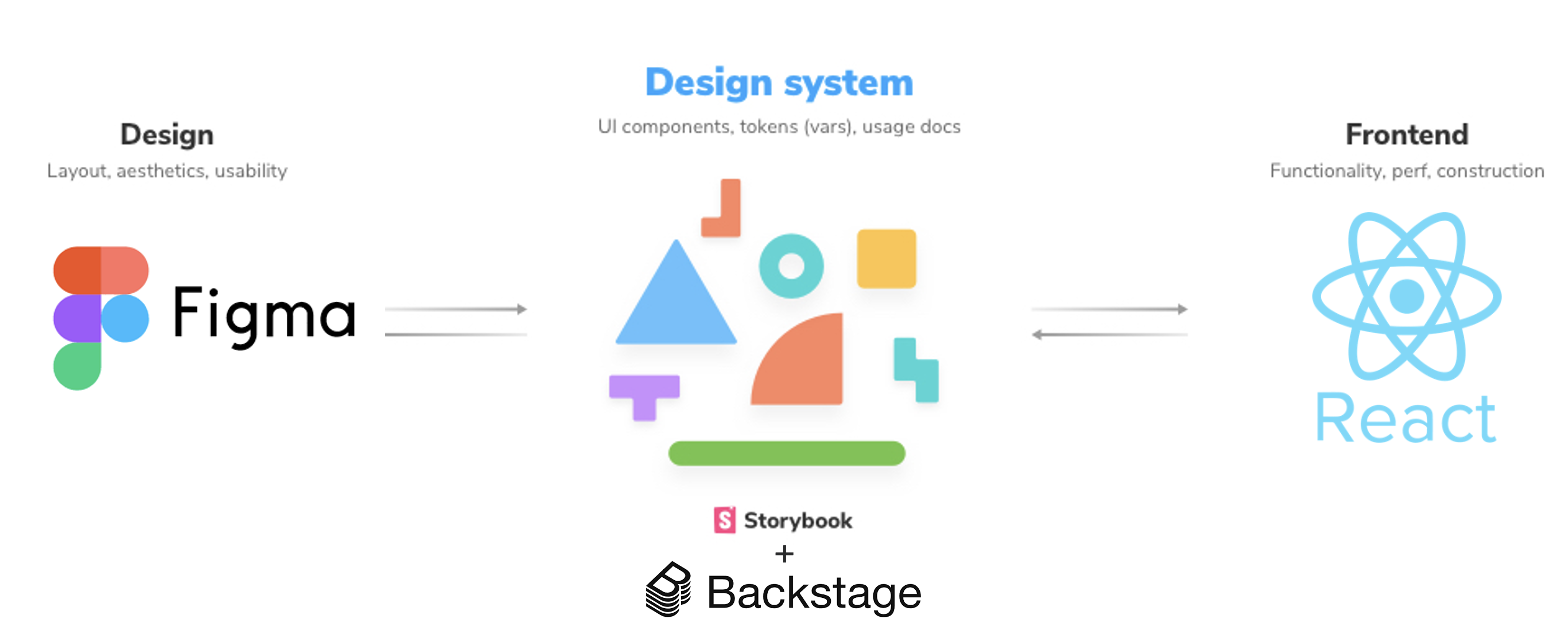
I led my design team to build the org's first unified design system — Material UI, in Figma — then drove its delivery to engineering and its organization-wide rollout. I owned the relationships and mentored the designers building the system to foster a productive partnership with the engineers who built and maintained it in Storybook. Developers worked from the same MUI foundation we designed with, so adoption beat translation — it spread across the org’s 20 product teams.
The design-system pipeline — designed in Figma, built and documented in Storybook and Backstage, and consumed by frontend engineering in React.
For PDLC and GILEs, delivery ran as a tight cross-capability partnership: weekly syncs with a senior designer on my team, the lead developer, and the product manager to pressure-test feasibility, build approach, and how the AI was evolving. Design handed prototypes to engineering once the technical approach was worked out, and the specs were process maps — the full lifecycle with outcomes, RACI, inputs, and where AI showed up at each step. Both tools shipped as live internal products, with GILEs meeting developers directly in Jira.
Outcomes
A design foundation and two shipped AI tools
80%
Design-system adoption across the org’s 20 product teams (~500 people)
2
AI tools shipped as live internal products — PDLC & GILEs
~30%
Projected gain in developer efficiency with GILEs
I built the design function for a brand-new organization: a shared design system every one of the 20 product teams adopted, a repeatable research-and-design process, and two shipped AI tools — translating raw executive vision into products and a foundation that outlasted any single project.
"Paige has proven to be an indispensable asset as Product Director, displaying a unique combination of strategic leadership and operational expertise. Her clarity in communicating what is needed builds a transparent and supportive work environment. Her investment in each team member's personal needs has fostered genuine camaraderie among us."
— Sam Sears, Product Owner, Concentrix
Context
A note on timing
My role ended in a late-2024 layoff during a leadership restructuring. I'll be candid: I do my best work in cultures that lead with research, user evidence, and human-centered design. I believe in collaboration, honesty, and genuinely caring about the people you work with — that's how you establish trust, ship quickly, and produce something that truly solves the problem. I'm clearer now than ever about how much that alignment matters to me. I'm proud of what endured: the design system, the process, and both AI tools were live and in use across the organization when I moved on.